
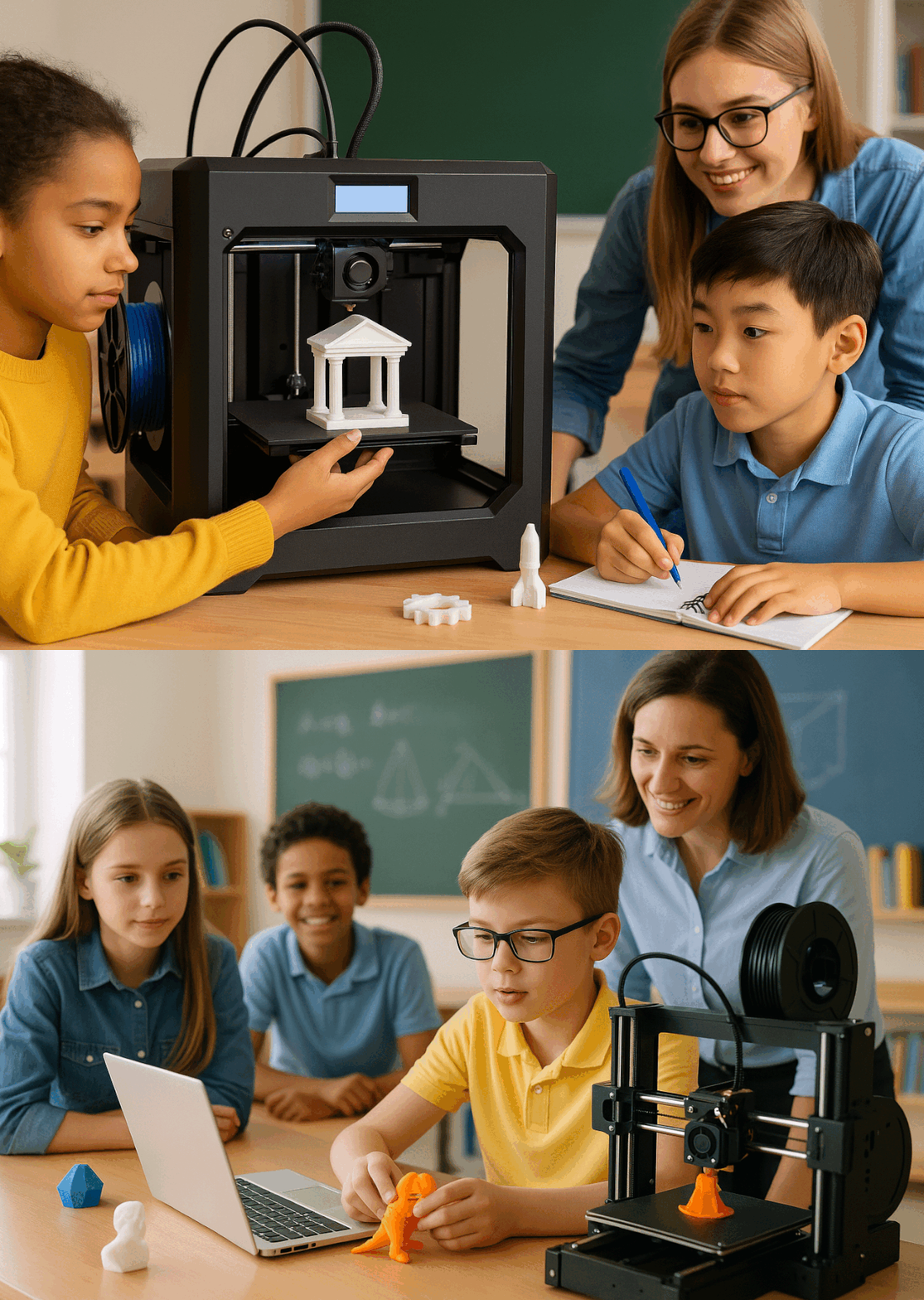
Save money and help new ideas grow. 3D Printing Service helps students learn by making hard subjects easier to understand, encouraging creativity, and getting them ready for jobs in the future. Autodesk Fusion and other tools can help with this.
Table of Contents:
- What Does It Mean To Print in Three Dimensions?
- Using 3D Printing In The Classroom
- Being Taught To Work Three Dimensionally
- Common Ways Schools Use 3D Printing
- Creating Tools To Support Teaching
- Designing and Making Prototypes
- Learning Tools That Can Be Changed
- Learning Through Stem Projects
- Inspiring Creativity In Art and Design
- Challenges Of Using 3D Printing In Schools
- The Future of 3D Printing in Education
What Does it Mean to Print in Three Dimensions?
Using computer-aided design (CAD) files, additive manufacturing, or 3D printing, lets you make things in three dimensions. This method builds a shape by adding materials one layer at a time. The most common types of these materials are plastics, metals, waxes, and composites. The whole thing is run by a computer. You can make almost anything with 3D printing, and it’s cheap, quick, and accurate.
A lot of different fields now use 3D printing to make prototypes, tools, jigs, parts, and parts that will be used. 3D printers come in a wide range of sizes. Some are small enough to fit on a desk, and others are big enough to work in factories. Larger printers can print bigger things, but they cost more and take up more room than smaller printers. Also, it can be harder to get a good print with a large-format printer because it takes longer to print more pages.
Using 3D Printing in the Classroom
3D printing is changing education by making it easier and more fun for kids to learn about things that are hard to understand. With this technology, students can make 3D models of their ideas, which helps them learn about how things work in the real world. For example, students can print out models of living things for biology, historical objects for history, and geometric shapes for math.
It helps them learn better when they can touch and feel what they are learning. Kids learn better when they have fun doing it, and this way is more fun.
3D printing also lets people be creative and come up with new ideas. Students can come up with ideas, build prototypes, and make their work better. This helps them learn how to think critically and figure things out.
The 3D printing also educates the students on the use of new means of creating things and digital design tools. This prepares them to go on. 3D printing is compatible with Autodesk Fusion and other applications, which is why they are excellent in design, engineering, and production.
When students apply technology in their real life, they acquire valuable skills that are much in demand by business. There are such fields as healthcare, architecture, engineering, and product design. Those students who will be taught how to work with 3D printers at school may gain an advantage over other students. Finally, it can assist them to deal with emerging issues and opportunities more effectively in a technologically fast-paced world.
Being Taught to Work Three Dimensionally
3D printing in school may contribute to students acquiring much helpful knowledge that can be applied at school and in the workplace. The most awesome thing about 3D printing is that it can serve as a way to improve your skills of designing and creativity which are two of the most valuable skills.
It requires students to be creative and create the unique three-dimensional objects to display their ideas. The computer-aided design (CAD) software allows them to understand the use of computer and digital design tools in a better manner. They also get to understand how to create an actual product out of a virtual model through 3D modeling.
People can also learn how to think critically and come up with answers through 3D printing. When students make and print their designs, they often run into problems that force them to change things and make them better. This habit of doing things over and over again teaches you how to keep going and how important it is to learn from your mistakes if you want to do well.
Students often work together to finish their homework, which helps them learn how to talk to each other and work with others. Kids can also learn a lot about science, technology, engineering, and math (STEM) by making things with 3D printing. This will help them get jobs in the future that use technology.
In general, 3D printing in schools gives kids a lot of useful skills that help them deal with today’s problems.
Common Ways Schools Use 3D Printing
Creating Tools to Support Teaching
A lot of people use 3D printing to make models that are very realistic and help explain difficult ideas. For instance, biology classes might use models of the body, history classes might use old things, math classes might use shapes, and chemistry classes might use chemical compounds. These tools help students learn about things that are hard to understand or not very clear.
Designing and Making Prototypes
Students can make things, make prototypes, and make things better with 3D printing. This program is great for students in engineering, business, and design schools because it helps them make their ideas real. They can try out their ideas, change them, and make models that work and are ready to go—just like they would when working with a Professional 3D Printing Service in industry.
Learning Tools That Can Be Changed
Teachers can use 3D printing to make learning tools that are perfect for each student’s way of learning. For example, teachers can make puzzles, manipulatives, and other fun learning tools that are just right for each student’s skill level and way of learning. This customization makes learning easier and more useful, especially for kids with special needs.
Learning Through STEM Projects
A lot of STEM (science, technology, engineering, and math) projects use 3D printing. Students can make and print things to help them with robots, physics experiments, and engineering problems. Not only does learning by doing help you remember what you’ve learned in theory, but it also helps you figure out how to use what you’ve learned in real life.
Inspiring Creativity in Art and Design
Art and design students can be more creative and find new ways to show who they are with 3D printing. Students can use 3D printing to make sculptures, jewelry, fashion accessories, and other works of art that would be hard or impossible to make by hand. This app not only gives kids more ways to be creative, but it also teaches them how to use a computer to make things, which is becoming more and more important in art and design today.
Challenges of Using 3D Printing in Schools
1. Cost
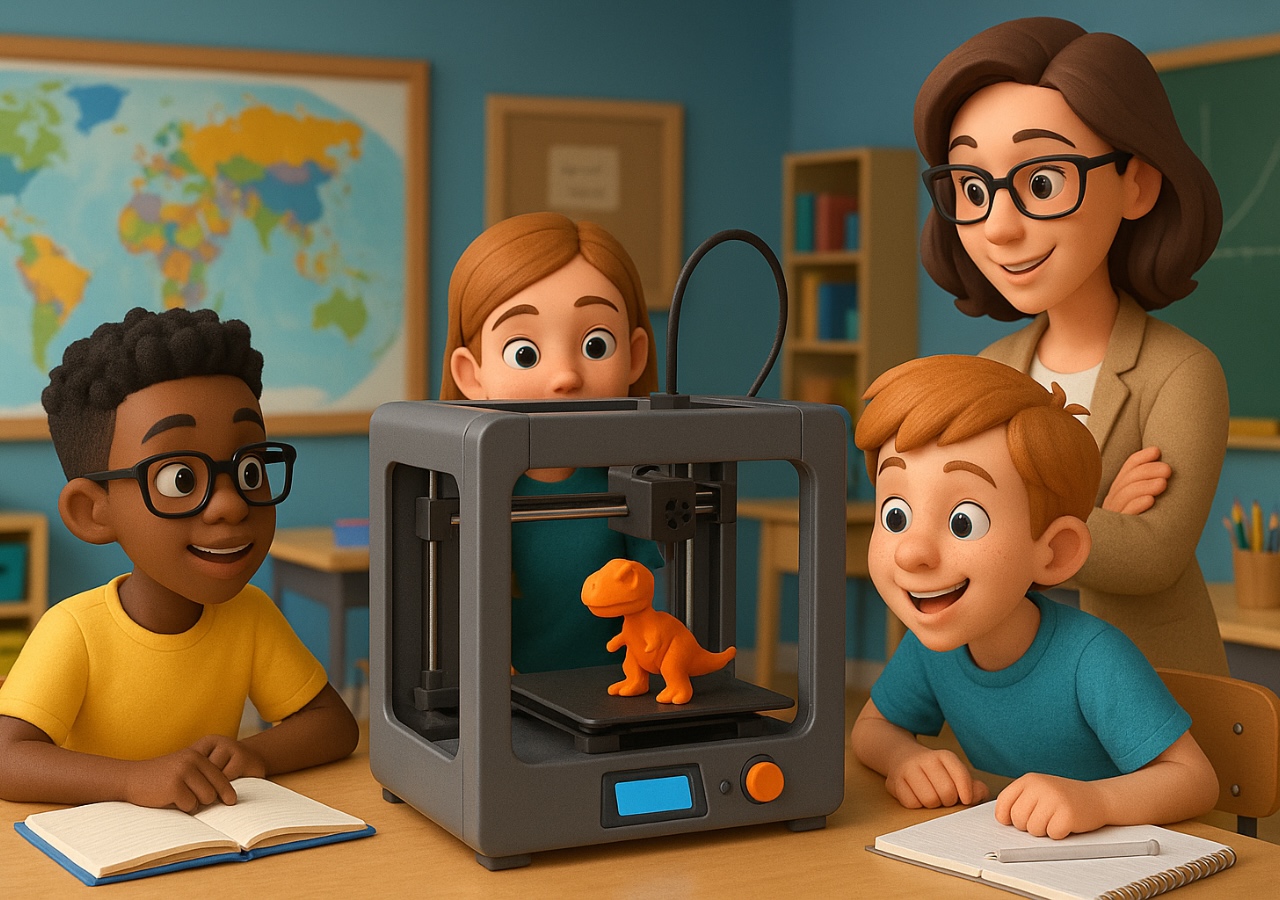
One of the biggest problems with getting schools to use 3D printing more is that it costs a lot. You can get a cheap 3D printer if you’re just starting out, but the cost of good machines, supplies, and upkeep can add up. Also, printers that can print with more complex materials, like metals and composites, cost a lot more. This makes it harder for them to get into schools, colleges, and universities that cost a lot of money. Schools also have to consider ongoing expenses like 3D Printing Service Cost when budgeting.
2. Not Enough Practice and Training
A lot of teachers don’t know much about 3D printing technology and might not know how to use it well in the classroom. People might not use the technology as much as they should, or they might not want to use it at all because they don’t know how it works. Teachers need a lot of training and ongoing professional development to learn how to use 3D printing in their classrooms.
3. Limited Material Options
In the majority of cases, entry-level 3D printers are limited to printing with only a small number of types of plastic such as acrylonitrile butadiene styrene (ABS) and polylactic acid (PLA). Such a rule may complicate the conduct of certain types of projects and experiments.
4. Maintenance and Technical Issues
Your 3D printers should be periodically checked and repaired. This can be very time consuming, and not every school is technically competent in their immediate needs.
5. Integrating into the Curriculum
Adding 3D printing to the existing curriculum may be difficult to determine. Educators should ensure that the 3D printing activities are aligned to what the children should be learning as well as the regulations.
6. Funding and Resource Allocation
It’s not always easy to get money for 3D printing projects, especially at schools that don’t have a lot of money.
The Future of 3D Printing in Education
There is a lot of potential for 3D printing in education. It might change how students learn and talk about different subjects. As technology gets better, it will become cheaper, easier to use, and more flexible, making it available to more schools.
Hands-on, experiential learning will help students understand difficult concepts in science, technology, engineering, art, and math (STEAM) because these subjects will be better linked. New trends like personalized learning paths, where students can change their projects to fit their interests and skills, will make it even easier for them to stay interested and remember what they learned.
Working with big companies like Autodesk will also help students learn the most up-to-date skills and information. This will help them get ready for jobs in the future, when technology changes quickly. In the future, 3D printing will be a big part of learning. It will help the next generation of students be more creative, think critically, and solve problems in the real world—whether they’re working locally, such as in 3D Printing Malaysia, or anywhere else in the world.
Contact Us, We’re excited to talk about all things 3D printing in education! If you’re curious about classroom projects, want to explore creative ideas, or have thoughts on how 3D printing can inspire the next generation, we’d love to hear from you. Let’s create something amazing together.