
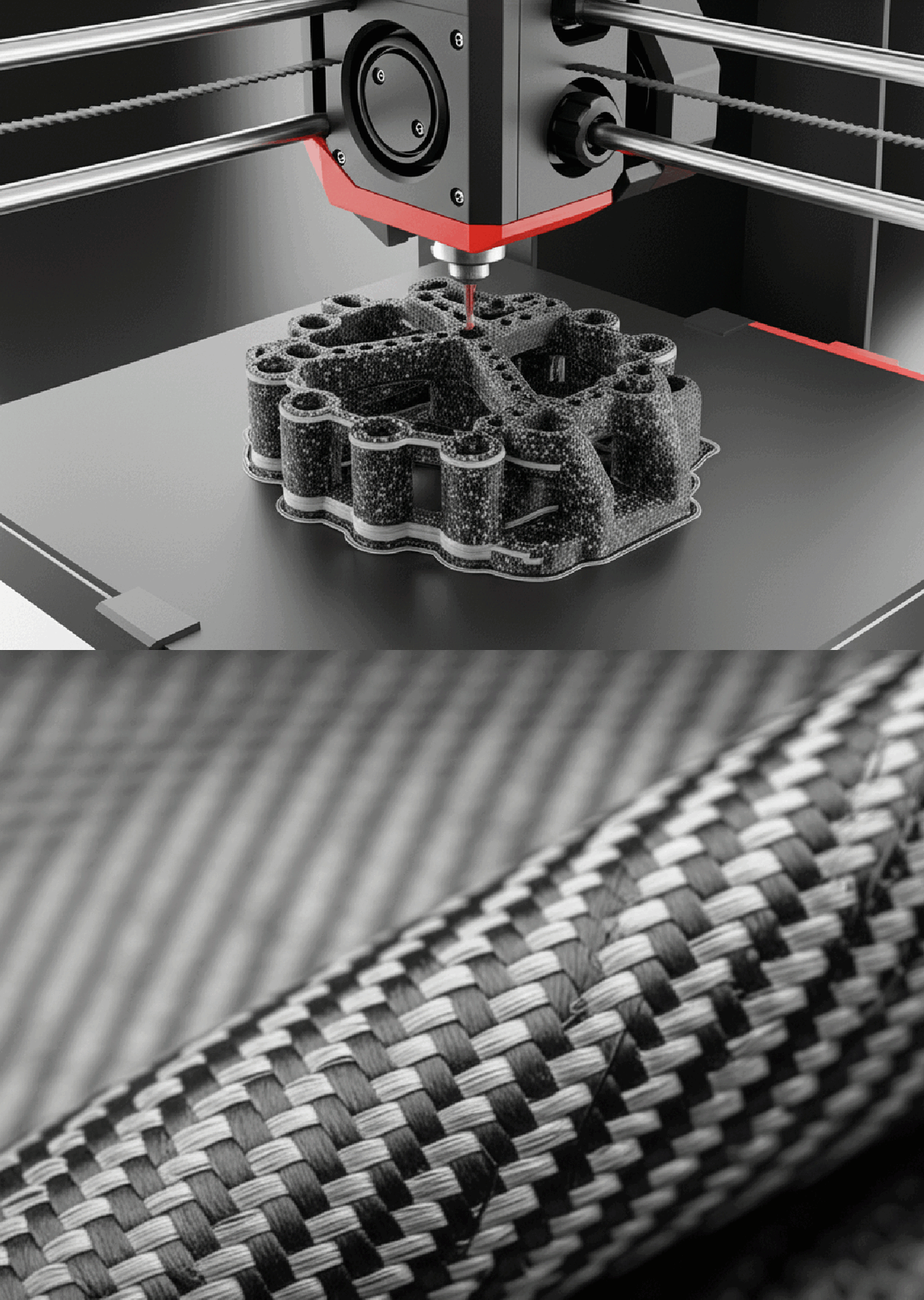
Carbon-fiber reinforced nylon is fast becoming one of the top materials in 3D printing for durable and strong-like-metal end-use parts. Used in everything from air intake manifolds on cars to any type of bracket, housing, or holder, this material enables strong parts in designs not possible with CNC machining and in quantities not affordable through injection molding. Whether you’re sourcing parts from a Malaysia 3D Printing Service or a global provider, this material offers unmatched performance benefits.
Table of Contents:
Understanding Carbon Fiber in 3D Printing
You don’t need to know anything about 3D printing to get your parts and prototypes manufactured with this material, but it pays to have a general understanding of your carbon fiber options since they will affect the price and performance of your final part. Carbon-fiber-infused nylon is available in filament form for FDM 3D printing, as a powder for selective laser sintering (SLS) 3D printing, and there’s also continuous carbon fiber (CCF) 3D printing which involves using a dual-extruding 3D printer to imbed an unbroken band of carbon fiber inside the molten nylon material.
Despite being the ideal material for durable parts, carbon-fiber-infused polymers are not offered by most service providers. Nylon alone, without added carbon fiber, can be strong enough for many industrial applications, but the added strength of the fibers is driving the sale of carbon fiber materials and 3D printers worldwide, so hopefully, more service bureaus will catch up to demand. For now, it’s best to explore Online 3D Printing Services that list carbon-fiber nylon among their available materials.
All You Need to Know to Order Carbon Fiber Parts
You may know carbon fiber from its use in the auto industry for lightweight race car bodies, in the marine industry for durable yacht hulls, or even in sports for helmets and golf club shafts.Manufacturers traditionally create these products with carbon fiber by layering sheets of fiber material into a curable resin. 3D printing with carbon fiber materials has similarities and differences.
Traditional methods involve labor-intensive layup processes, molds, and autoclave curing. 3D printing simplifies the process by eliminating the need for molds and enabling direct fabrication from digital models, which can drastic reduce the cost for prototypes and small batch production.
Traditional manufacturers focus on producing large-scale, simple shapes, while 3D printers excel at creating complex, customized small to medium-size parts.
When ordering carbon fiber parts from a 3D printing service online you need to be aware of the different types of carbon fiber materials on offer and the different technologies used to 3D print the parts.
Types of Carbon Fiber and Base Plastics
First, let’s look at the materials. In 3D printing, carbon fiber is the additive to a base plastic. That plastic can be a standard PLA, which wouldn’t have the mechanical properties you’d need for a manufacturing tool, or the plastic could be nylon, which is already a tough material and ideal for tools. Don’t make the mistake of thinking that all carbon-fiber materials are the same. Carbon-fiber nylon, PET, PETG, PAHT, and PEEK are all good choices for durable parts.
Aside from the type of plastic the carbon fiber is in, there are three different types of carbon fiber. A material could have milled fibers in it, which are typically for aesthetic purposes. Milled fibers give plastics a matte finish and hide layer lines, which is great for prototypes that need to look just like injected molded parts.
The next type of carbon fiber is chopped. Plastics can have varying percentages, from about 10% to 35%, of chopped fibers imbedded providing various mechanical properties. These fibers, when heated during the 3D printing process, align in the direction of printing to provide strength.
The last and strongest fiber option is continuous, unbroken carbon fiber. Continuous carbon fiber (CCF), involves dual extruding nozzles where one lays down a layer of continuous carbon fiber while the other lays down a layer of another plastic material. This method creates parts that are stronger than using chopped fibers and provides a more consistent load distribution. It’s ideal for parts that don’t require carbon fiber throughout, but, instead, reinforcement in specific areas – just on the outer wall, for example.
How to Choose the Right Fiber Type?
How do you know if your parts require chopped or continuous? You could order one of each and test them or talk to the service provider about the mechanical properties your part requires.
Note that chopped fibers are the most commonly provided by Professional 3D Printing Services by far, and you’d have to go out of your way to find continuous fiber 3D printing. But if this is what you need, look for a service that offers 3D printing on printers by a company called Markforged.
Just a few last tips on ordering carbon fiber parts: When you see Carbon DLS as a technology option, here Carbon refers to the name of the company, and it does not print with carbon fibers. Although Markforged likely remains one of the only options for continuous carbon fiber 3D printing, some companies offer only Markforged Onyx, which contains chopped carbon fiber. If you want continuous fiber, confirm that the Onyx includes continuous carbon fiber reinforcement.
Other 3D Printing Technologies for Carbon Fiber Materials
Up to now, we’ve been talking about extruding carbon-fiber-infused material using a 3D printer technology called fused deposition modeling (FDM). But there’s another 3D printing technology compatible with carbon fiber infused materials, selective laser sintering (SLS).
Prized for its ability to create engineering-grade polymer parts with excellent mechanical properties and fine resolution incredibly fast, SLS 3D printing is what engineers and industrial designers turn to for functional rapid prototypes and end-use parts.
SLS 3D printing uses high-powered lasers to fuse powdered plastic material, usually nylon, together into 3D shapes. It can create parts that are finely detailed, strong, durable, heat resistant, and flexible (when needed) all at once.
SLS also offers a high degree of predictability in material and mechanical properties, so it’s popular in aerospace, medical, and regulated industries. Furthermore, SLS printing is mostly support-free, which expands your ability to design and produce very complex geometries and cut down on post-processing time removing those supports.
Multi Jet Fusion (MJF) from machine and material HP is also a commonly used technology for jigs and fixtures, but there are no carbon-fiber materials available for MJF. Instead, MJF offers a glass-bead infused nylon 12 in addition to other nylon materials.
Conclusion
Carbon-fiber reinforced nylon is one of the strongest, most cost-effective options available in the additive manufacturing space today. With a variety of base plastics and fiber types to choose from, businesses can customize parts that match their mechanical needs and production goals. Whether you’re prototyping or scaling up, these innovations are making advanced manufacturing more accessible than ever—even for niche markets like 3D Printing Designs Malaysia.
Contact us to explore how carbon-fiber reinforced nylon can elevate your next project. Our team is ready to guide you through the process and help you get high-performance parts with precision and speed.