
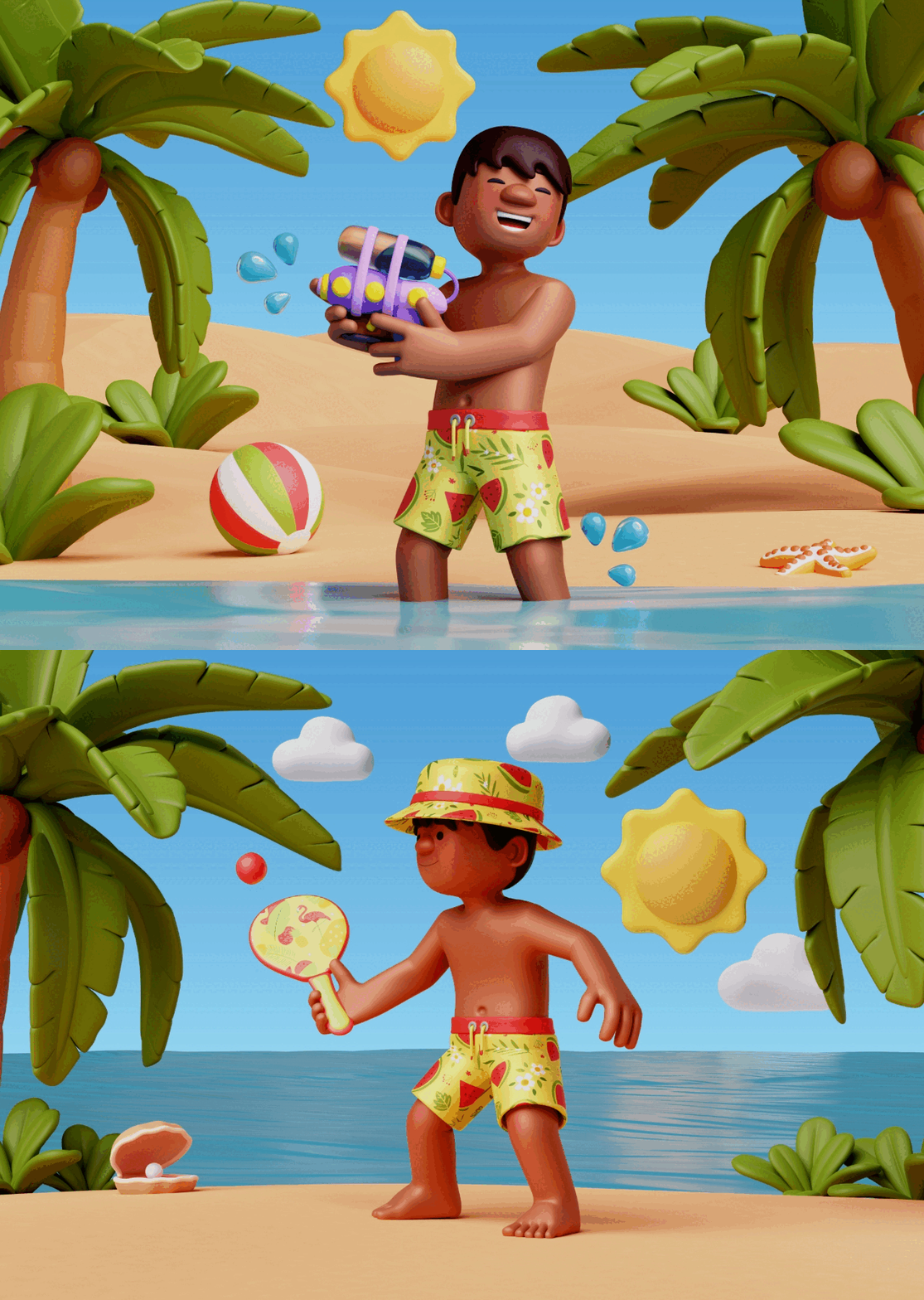
Most people don’t realise how complicated the process of making a 3D animation is. Different Animation Studios and project sizes significantly vary the number of processes required to create a 3D animated piece.
However, to make a 3D animated video or feature film, the 3D animation studio must hire a huge team of individuals with a variety of skill sets and complete a long list of activities. The studio needs to establish a strong structure and thorough framework to move such a complex process forward effectively and economically: pipeline for 3D Animation.
Table of Content:
What is an Animation Pipeline?
A 3D animation product or asset is the end result of an animation process, also known as a pipeline, which is a system of people, hardware, and software that are all arranged to operate in a particular sequential sequence to complete predetermined tasks in a predetermined amount of time.
Either a typical animation, like a feature film, short film, animated commercial video, television program, game trailer, or video game component, or something entirely different, could be the end result. For the creation of 3D animated videos, it is comparable to an assembly line.
The use of 3D animations in transmedia narrative projects has increased recently among animation studios. Before proceeding to the following section, we advise anyone who are unfamiliar with the subject to read our essay on what transmedia storytelling is.
Most 3D animation projects at Dezpad Designs are completed using the process below:
Important Elements Of The Pipeline For CGI Animation
There are three primary steps in the production pipeline for 3D animation:
-
- Pre-production
- Production
- After-production
Each sector of the 3D animation industry uses the three stages slightly differently depending on organisational considerations, resources, results, and other factors, but the basic framework is always the same. Additionally, each project’s pipeline may have slightly different details. The three primary phases, however, are unchanged once more.
1. What Is Pre-Production In The Animation Pipeline?
Pre-production covers the entire 3D project’s research, design, and planning phase. Two teams handle this phase: the management team drafts the production plan—including teams, budgets, and timelines—while the design team develops the concept, narrative, and designs. Completing pre-production well simplifies the production stage.
The following steps comprise pre-production:
Concept Generation: A creative concept is the foundation of any great story. Thus, having a strong, well-considered idea is crucial for an animation to succeed.
Story Creation: Writers and creators refine and expand concepts until they form the overall plot. They develop a basic representation of the characters, conflict, and other elements that will appear in the animation.
Script: Writers craft the formal, written version of the story, including character motions, setting, time, events, and dialogue.
Storyboarding: A storyboard is a graphic representation of the script that is not moving. It essentially has the appearance of a comic book, complete with early concepts for scene events, key character stances, and camera staging.
Animatic: The animatic is a moving version of the storyboard that will eventually become the final project edit. In its most basic form, the animatic uses 2D storyboard drawings to illustrate the project’s sequence pacing.
Design: Design: At this point, the team determines the project’s ultimate appearance, covering concept design, character design, environment, costumes, and prop design. They must clearly communicate the design concept and tone. If you’re interested in learning the specifics of character design, read the page that explains shape language in character design.
Find out what we discuss when we discuss design in animation pre-production by reading on.
2. How Does One Go About Creating A 3d Animation?

All of the earlier work must culminate in action at the production stage. At this point, the assigned teams and artists will receive the visual components of the 3D animation. Team leads ensure that everything runs as smoothly as possible and that the time frames and quality align with the pre-production strategy. The entire 3D animation is shaped by the conclusion of this step.
The following steps make up the production stage:
3D Layout: To put it simply, a 3D layout is a 3D representation of a 2D animatic. Basic 3D attributes including the characters’ size, form, and environment, as well as a basic character animation and proxy geometry, are all included in the 3D layout.
3D Modelling: Artists use specialised 3D software like Maya or 3Ds Max to create a geometric surface representation of any item.
Texturing in 3D: Texture artists generate and apply textures (colours and surface characteristics) to 3D models, which usually arrive in a default shaded flat colour.
3D Rigging: Artists add a bone structure to 3D objects so that animators can move various geometric elements quickly and efficiently, as in character rigging.
3D Animation: Animators produce the motions of 3D objects or actors within a scene or environment. This phase typically represents the most important and time-consuming part of creating a 3D animated video.
VFX: A 3D animator can animate almost everything, but key-framing features like hair, fur, water, fire, clothing, or dust proves too challenging or even impossible. The team creates these components during the VFX portion of the pipeline, though you may not realise certain aspects of the visual effects phase contribute to 3D animation development.
Lighting: The lighting team establishes the mood of a 3D scene or sequence using light based on pre-production concepts, similar to how photographers or filmmakers use real-world lighting.
Rendering: The team breaks every scene in a 3D animation into several layers—objects, colours, foreground, backdrop, shadows, highlights, and more. In the post-production phase (compositing), they reunite the layers.
3. What Is The Post-Production Process For Animation?
At this point, the team applies the finishing touches to the project to make it appear polished and professional (though, of course, different projects may define “polished and professional” differently). With a variety of tools at their disposal, post-production artists can customise a project’s appearance.
In the pipeline for 3D animation, post-production consists of:
Compositing: Compositing is the process of reassembling previously rendered layers to create a final output. Layering can be as easy as joining two layers or as complicated as matching hundreds of levels and modifying their characteristics.
2D VFX: At the end of the project, it is easier to create some visual effects—like sparks, dust, rains, camera shakes, etc.—in a 2D environment without compromising quality. In compositing, these effects are typically combined with other layers.
Colour Correction: The team applies colour correction—often referred to as colour timing or colour grading—as the final modification to a 3D animation. Every shot and the entire project appear more consistent after this process.
Final Output: There are various choices available for the pipeline’s output format. Nonetheless, most teams produce a digital video, which audiences can view online and access on the majority of digital devices.
What Distinguishes The CGI Workflow From 3D Animation?
Computer-generated imagery, or CGI for short, is the use of computer graphics to create or use pictures in commercials, feature films, TV shows, game art, and other media. Since both CGI and 3D animation employ the same processes and approaches to produce and utilise art in many contexts, there is no distinction between the two. The growth of 3D Animation Services is a result of this increasing integration across industries.
Why Is A Pipeline Used In The Creation Of 3D Animation?
The 3D animation pipeline may be thought of as a creative assembly line where everything is preplanned from ideation to release. There might be as few as two artists in the pipeline overall, or as many as 500. The most important aspect of establishing a workflow is that each of these artists needs to understand precisely what, when, and how to complete the tasks at hand before turning them off to the next artist or group of artists.
In general, there are four primary justifications for employing a pipeline in the creation of 3D animation:
1. Effective Time Management
3D animation production is a difficult and time-consuming process, particularly for feature films and 3D animated series. When compounded, even small micro-delays in each phase can delay the final result and cause a cascade of financial catastrophes for the entire project. Therefore, the team must develop a comprehensive strategy that coordinates many creative lines—some of which they intend to complete concurrently—and sets a detailed time range for each stage.
2. Budget Management
3D animation projects typically require a sizable budget, so teams must spend funds carefully to ensure effectiveness, even though expenses and budgets can vary depending on several factors. Most 3D Animation Projects have their ROI determined before production begins.
3. Team Management
An animation project may require as many as 500 individuals. These individuals are typically divided into a number of teams and groups, the majority of which need to cooperate in order for the project to succeed. The importance of overseeing these groups and individuals with varying roles and abilities is something you should not overlook.
4. Standardisation and Structure
The most effective method to ensure that everyone is working towards the same objective and is in agreement is through a well-planned pipeline. Reputable animation firms like Dezpad Designs create hundreds of 3D cartoons annually for a range of clients. You can stand out from the competition and attract even more clients by producing each animation with sufficient accuracy and quality, ensuring that clients always receive the same amazing experience. That’s why hiring a reliable 3D Animation Agency is crucial.
3D Animation’s AI Revolution: 2025 Update
The changes have been nothing short of spectacular since we first examined how AI was changing 3D animation. By 2025, artificial intelligence has transformed every stage of the animation process, reshaping how creators develop stories from the initial idea to the finished, polished product.
Artificial intelligence (AI) systems are helping with a number of pre-production chores, including storyboard creation, script analysis, and even audience reaction prediction. It helps teams make well-informed decisions before they even begin animating, making it similar to having an exceptionally productive creative partner.
Some of the most labour-intensive tasks are being replaced by AI as production starts. Machine learning is freeing up animators to focus on what really matters: the creativity of their work, whether that means automatically synchronising language with character lip movements or improving motion capture data. For example, Dezpad Designs has adopted these technologies to improve its workflow, enabling their creative teams to create even more inventive and captivating content. This evolution in 3D Animation Technology has transformed both speed and quality.
AI is having a big impact even in the latter stages of production. Thanks to AI-driven upscaling and denoising techniques, rendering—once a key bottleneck—is now much faster. This implies that studios may produce stunning images more quickly without requiring massive resources or expensive equipment.
AI is becoming into a true creative partner, not merely a tool for expediting tasks. By handling the technological difficulties, it enables artists to let their imaginations run wild and discover previously unthinkable possibilities.
Summary
Making a 3D animation is a challenging process that requires a wide range of hardware, a long list of activities, and a sizable team with varying roles and skill sets. A robust production workflow is required to maintain the process’s flow and affordability.
A 3D animation pipeline arranges personnel, equipment, and software to perform predefined tasks within a set timeframe by working in a specific sequential order. Following this process will result in a 3D animation product or asset, such as a 3D video game asset, television program, short animation, or feature film. If you’re looking for expert help, consider partnering with a leading 3D Animation Company In Malaysia to turn your vision into a compelling animated reality.
Ready to bring your vision to life? Contact Us today to collaborate with a leading 3D animation company in Malaysia.