
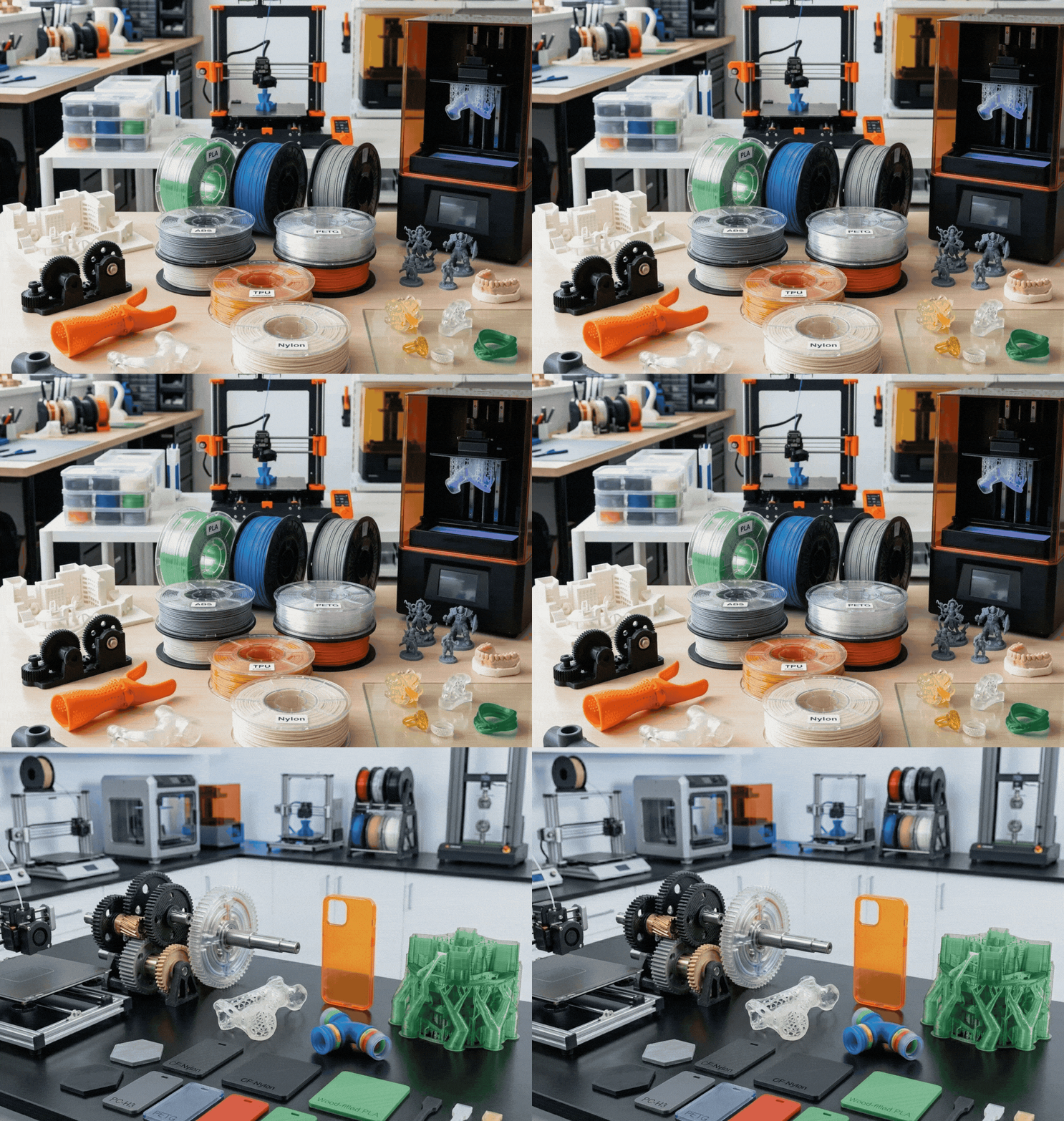
3D Printing is a great way to make prototypes or parts quickly and affordably.Picking the right material is essential to getting the right strength, function, or look. This guide covers the most common plastic and metal materials used in 3D printing, explains their features, uses, and gives tips to help choose the best one for your project.
Table of Contents:
Plastic 3D Printing Materials and Techniques
There are many kinds of plastics used in 3D Printing Materials, and each works best for different purposes. Knowing the type of material and the printing technique helps you make the best choice.
Types of Plastic Materials
-
- Thermoplastics: These can be melted and reshaped several times.Examples include PLA, ABS, and PETG. They are easy to recycle and very versatile.
- Thermosets: These harden permanently once cured and can’t be melted again. Most SLA resins fall into this category.
Plastic 3D Printing Techniques
-
- Fused Deposition Modeling (FDM): This method heats and extrudes thermoplastic filament layer by layer.
- Stereolithography (SLA): A laser is used to cure liquid resin through a process called photopolymerization.
- Selective Laser Sintering (SLS): A laser fuses thermoplastic powder layer by layer.
FDM 3D Printing
This technique is widely used both by individuals and in industry settings. Advantages is that it is affordable, good for creating simple models, and suitable for early-stage prototypes.Disadvantages is that it has lower resolution, and parts can be uneven in strength.It may require extra steps like sanding or painting to finish the surface.
Popular FDM Materials
-
- ABS: Strong and heat-resistant, makes great functional models.
- PLA: Easy to print, biodegradable, and good for visual models.
- PETG: Durable and chemically resistant, ideal for parts with snap-fit features.
- Nylon: Strong and flexible, suitable for parts that need to withstand wear.
- TPU: Flexible and impact-resistant, makes parts that can bend.
- Composites: Such as carbon fiber or Kevlar, used for industrial-level parts requiring high strength.
- Support Materials: PVA (water-soluble) and HIPS (limonene-soluble) are used to support complex shapes during printing.
SLA 3D Printing
SLA is the earliest form of 3D printing and is ideal for creating detailed and precise parts.Advantages is that it produces smooth surfaces, consistent strength in all directions, and is suitable for making functional parts, molds, and detailed models. Disadvantages is that it can be sensitive to UV light and is more expensive than other methods.
Popular SLA Materials
-
- General Purpose Resin: Produces smooth, high-quality models.
- Clear Resin: Makes transparent parts.
- Fast Model Resin: Speeds up the prototyping process.
- Color Resin: Allows for custom-colored parts.
- Tough & Rigid Resin: Durable, stiff, and heat-resistant, suitable for functional parts and molds.
- Flexible/Elastic/Silicone Resin: Offers rubber-like properties for parts that need to bend or compress.
- Medical/Dental/ESD/Jewelry/High Temp/Alumina Resin: Specialized resins made for specific uses with certain performance requirements.
SLS 3D Printing
SLS is good for creating strong, functional parts, especially those with complex shapes without needing support structures. Advantages is that it produces parts with uniform strength, good for rapid prototyping, functional parts, and small-scale manufacturing.Disadvantages is that he range of materials is limited, and it is a more expensive option.
Popular SLS Materials
-
- Nylon 11 & 12: Strong, durable, and resistant to impact and chemicals, ideal for functional models and medical devices.
- Composites: Reinforced with glass, carbon, or aluminum for greater strength.
- TPU: Offers flexibility and shock absorption, used for making flexible parts.
Comparing Plastic 3D Printing Materials and Techniques
| Technology | Advantages | Disadvantages | Best Use |
| FDM | Affordable, easy to use, widely available | Lower accuracy, parts can be uneven in strength | Low-cost prototypes, simple shapes |
| SLA | High accuracy, smooth finish, consistent strength | More expensive, sensitive to UV light | Functional parts, detailed models, molds |
| SLS | Strong parts, complex shapes, no need for support structures | Limited material options, higher cost | Functional parts, small-scale manufacturing |
Metal 3D Printing

-
- Metal FDM: Uses metal rods mixed with polymer binders and then sintered after printing.
- SLM & DMLS: Fuses metal powder with a laser layer by layer to create strong and precise parts.
Popular Metal Materials
-
- Titanium: Light, strong, and resists heat and corrosion.
- Stainless Steel: Strong, can bend and resist corrosion.
- Aluminum: Light, strong, and has good thermal properties.
- Tool Steel: Hard and scratch-resistant, useful for making tools.
- Nickel Alloys: Strong and heat-resistant, suitable for high-temperature applications.
Alternatives to Metal 3D Printing
-
- Using SLA for casting provides a lower-cost, faster, and more flexible way to create parts.
- Electroplating SLA parts can give a combination of plastic flexibility and metal strength.
- Framework for Choosing the Right Plastic 3D Printing Material
Step 1: Understand the Performance Needs
-
- Low-performance: Use for form/fit prototypes (PLA, general-purpose resins).
- Moderate-performance: For validation or pre-production parts (ABS, engineering resins, SLS Nylon 11/12, TPU).
- High-performance: For end-use parts that need strength and lasting performance (FDM composites, SLA medical/dental resins, SLS reinforced Nylon, TPU).
Step 2: Translate to Material Requirements
-
- Tensile Strength: FDM PLA, SLA Rigid/Alumina 4N, SLS Nylon 12/composites.
- Flexural Modulus: PLA for high stiffness, ABS for moderate, SLA Rigid/Tough/Elastic, SLS Nylon 12/composites.
- Elongation & Flexibility: ABS, TPU, SLA Flexible/Elastic/Silicone 40A, SLS Nylon 11/12, TPU.
- Impact Resistance: ABS, Nylon, SLA Tough, SLS Nylon/composites.
- Thermal Performance: SLA High Temp/Rigid/Alumina, SLS Nylon/composites.
- Hardness & Tear Strength: TPU, SLA Flexible/Elastic/Silicone 40A.
- Creep & Compression Set: ABS, SLA Rigid/Alumina, SLS Nylon/TPU.
Step 3: Make a Choice
-
- Narrow down to one or two materials based on performance, cost, and the specific needs of your project.
- Consider which 3D printing technique—FDM, SLA, or SLS—best suits your application.
Contact Us
Our team offers expert support as a 3D Printing Company Malaysia for everything from rapid prototyping to full-scale industrial manufacturing. As a leading 3D Printing Company In Malaysia we can help you pick the best material and printing method for your needs, whether it’s about strength, flexibility, precision, or performance. Get in touch with 3D Printing Service Selangor today to discuss your project, request a quote, or get tailored recommendations.