

Whether we like it or not, artificial intelligence is starting to permeate every aspect of our lives. Its capacity to forecast results, streamline processes, and adjust instantly is spurring innovation in a variety of sectors, including additive manufacturing. Manufacturers like 3DCeram now use AI to automate procedures and increase productivity, while companies like Nike use it to create creative shoe designs. AI-powered machine learning streamlines processes and opens up new possibilities for 3D printer users by enabling machines to swiftly analyse large volumes of data and make decisions on their own. The advent of AI 3D model generators, which seem to be the next big thing in this field, currently stands as one of the most exciting developments.
Although these tools have been around for a while, their creators originally built them for animation, video games, and other digital formats—not 3D printing. Nonetheless, both developers and enthusiasts now show strong interest in this technology’s potential in additive manufacturing. Numerous upgraded AI 3D model generators have recently hit the market. Through MakerWorld, Bambu Lab unveiled a generator earlier this year that lets users design 3D-printable fantasy animals from a picture or text prompt. Backflip, a generator developed by the founders of the 3D Printing Company In Malaysia Markforged, obtained a $30 million Series A investment in December 2024—indicating significant momentum in this developing field.
Table of Contents:
Why You Should Use an AI 3D Model Generator?
Bringing AI-generated 3D models to life with a 3D Printing Service forms a perfect combination because it allows users to create unique objects that often prove challenging to produce using traditional methods. Users can use these tools to come up with clever and creative designs—or at the very least, get ideas! Compared to creating models by hand or employing a professional designer, AI-powered 3D model generators generate designs in a matter of minutes, saving a substantial amount of time and money. These AI tools currently create simple models well and inspire original ideas, but they usually don’t suit complex details or precise mechanics.
We can anticipate that AI-generated models will soon be print-ready straight out of the box as technology develops. For now, these models serve as a basis—one that users need to further develop to prepare them for 3D printing. This guide will teach you how to use AI 3D model generators, including what services are available, how they operate, and how to make the most of the technology.
Choose a Generator Service for 3D Printing
The first—and possibly most difficult—step in using an AI 3D model generator involves choosing a service, which comes before deciding what you’re going to create. The market already offers dozens of generators, and as AI continues to grow in acceptance and accessibility, new ones appear regularly. Some available programs include Rodin Gen1, 3D AI Studio, Meshy.ai, OpenAI Point-E, PrintMon Maker from Bambu Lab, DreamFusion from Google, and Magic3D from Nvidia.
Not all of these generators, though, create models good enough for 3D printing. Some generate designs with “AI bumps”—tiny, asymmetrical flaws or protuberances. This constraint actually simplifies your selection, though AI hiccups may become less of a problem as services improve. Currently, two of the best options for 3D printing are DeemosTech’s Rodin Gen1 and PrintMon Maker. If it delivers on its promises, Backflip should join this list.
Since many, if not all, of these generators offer the ability to export models as STL files or other 3D-printable formats, all of them could theoretically produce a model for 3D printing. The problem lies in the model’s quality. Some AI models come with rough edges and ambiguous details. Rather than a realistic painting, imagine an impressionist piece. Others, such as Rodin Gen1, frequently express details precisely enough to justify 3D printing a design with minimal editing.
All of these services offer paid upgrades and subscriptions, but some also offer free options. Examine the differences between services before committing—we advise reading reviews. Which 3D Printing Service Online options have people found to be successful? Which one will fulfil your needs
Craft Your Prompt to Shape the Output
One important factor to consider involves how an AI 3D model generator responds to prompts. All take text prompts, most take image prompts, and a few accept videos. Consider what you wish to create. You should write a text prompt that’s as detailed as possible. For instance, instead of just “a superhero with a cape,” go a step further and write, “a defiant, cartoon-style female superhero with a cape flapping in the wind, with her right hand stretched out in front of her.” It can be beneficial to be specific and include style, materials, and positioning. The play and experimentation are what make this enjoyable—so let your creativity run wild.
You can use image prompts for more literal recreations or just as experimentally. For instance, you could upload images of a building you saw on vacation from various angles to make a miniature version. Some generators let you combine images to make a design—great for funky mashups or more lifelike objects. Imagine combining a man and a bird image into a creature with a bird’s head and human body.
Generate the Design and Explore the Variations
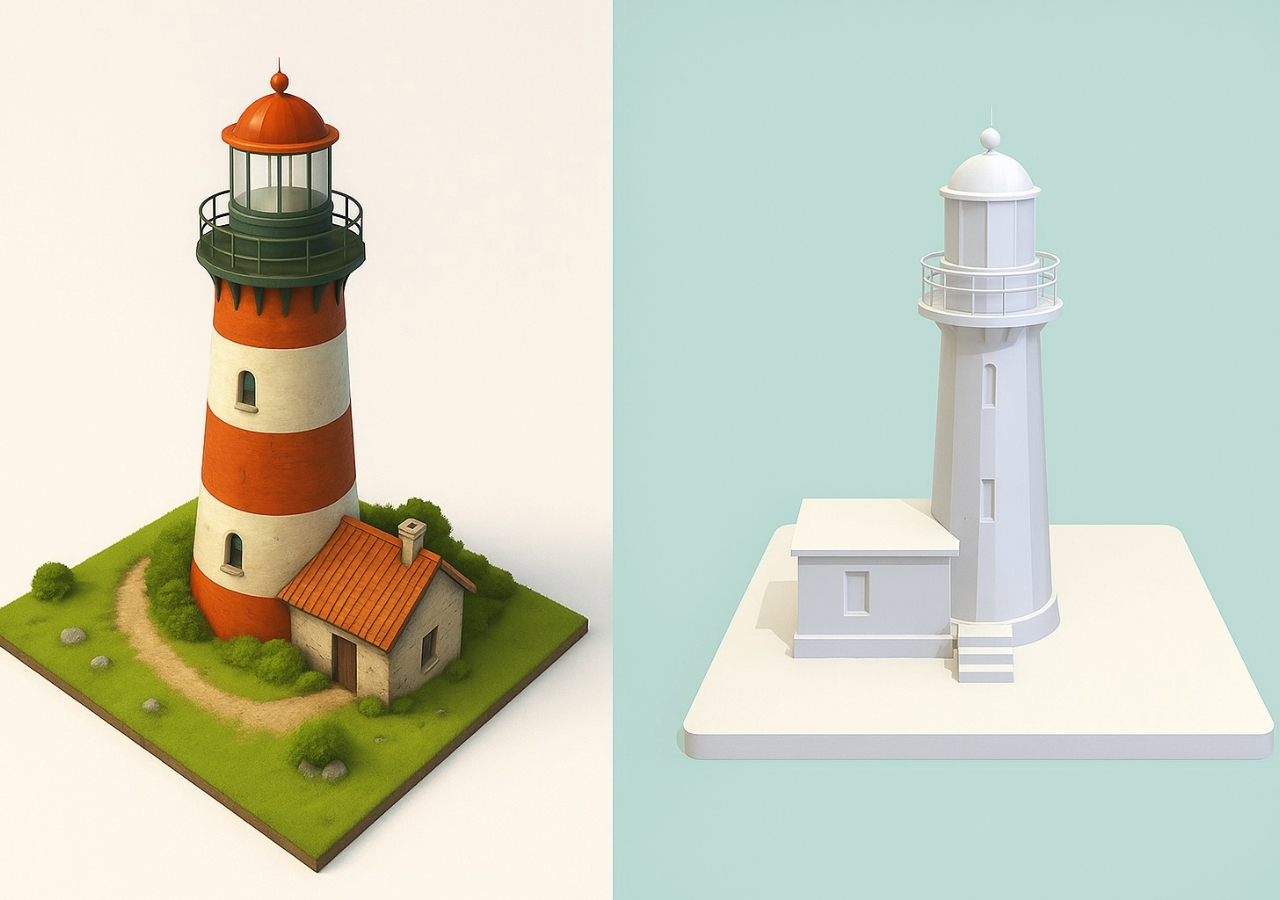
Once you’ve perfected your prompt, generate your design by clicking “generate” or the equivalent program-specific command. Many of the mentioned services then provide multiple design iterations. You can change your prompt, run it again for more variations, or select one you like and proceed. The generator then transforms your selection into a more intricate 3D model that you can further edit.
Export the File, Make Edits, and Print the Design
Once satisfied with your model—or at least ready to move forward—export the 3D file in your desired format. You’ll likely want to edit it after exporting. For instance, you’ll need a flat bottom on the model for good adhesion to the build plate. You might need to slice off a bottom layer to make it level. You may also need to make other design adjustments to ensure a successful print. After completing your design edits, proceed with slicing, printing, and post-processing as normal.
Professional 3D Printing Services make this process more accessible, especially if you don’t have a printer yourself. Many services also offer high-resolution results and can handle more demanding print materials.
AI and the Future of 3D Printing Innovation
AI 3D model generators are still in their early development, but we anticipate explosive growth in this field in the near future. You should learn about the technology now because it will undoubtedly shape the future of 3D printing. From ideation to production, using a 3D Printing Service can help bring your AI-generated ideas to life with ease, precision, and professionalism. The growing demand for 3D Printing Products Malaysia-wide confirms how valuable and accessible this technology has become.
Have questions or need support? Our team is here to help you explore solutions and bring your ideas to life. Reach out today — we’d love to hear from you.