
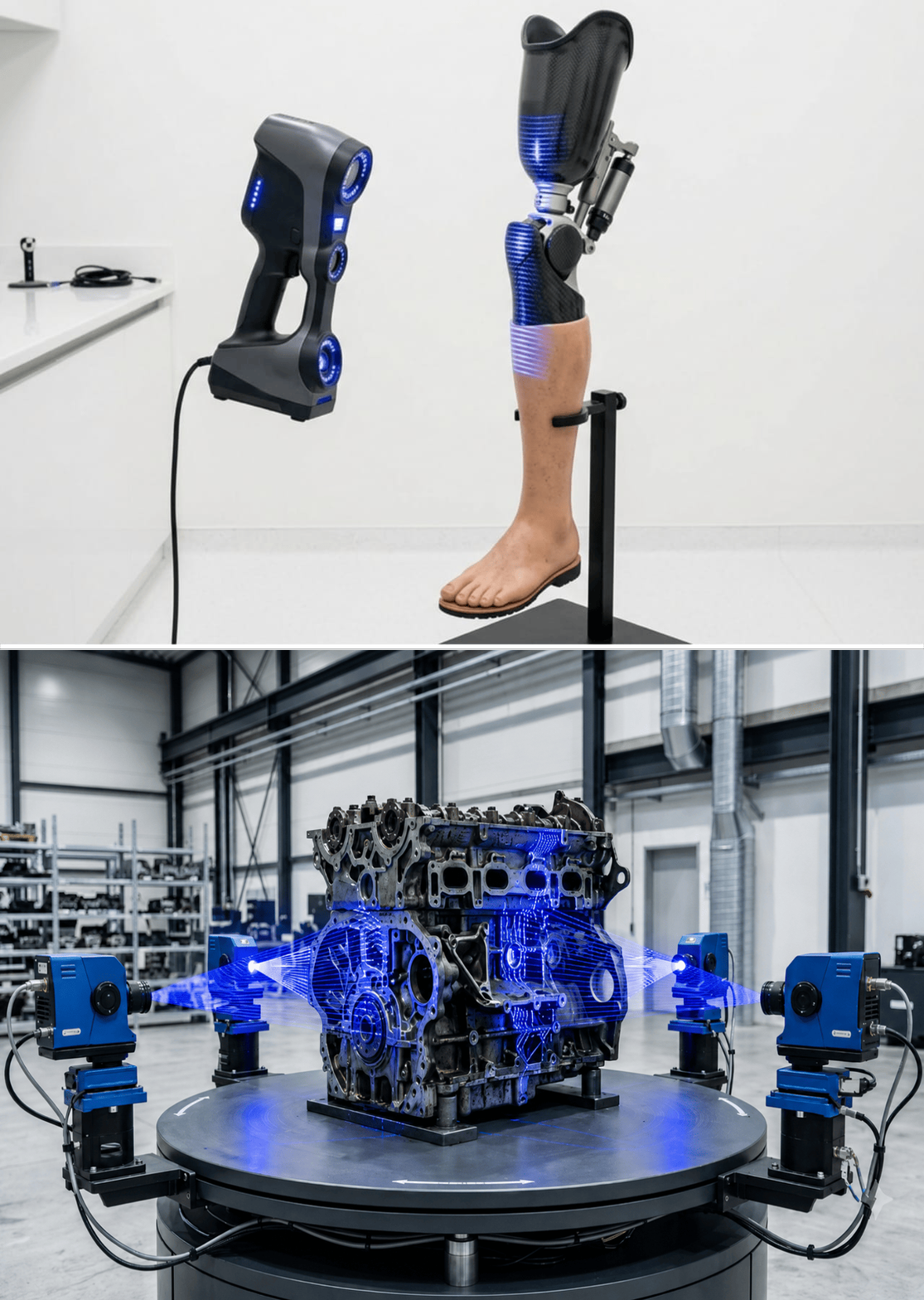
3D Scanning Services in Malaysia continue to improve in speed, accuracy, and portability, making them valuable tools for manufacturing, aerospace, automotive, engineering, quality control, reverse engineering, and product development. Modern scanners can capture highly detailed 3D models while reducing scanning time and simplifying workflows.
Recent additions include the FARO Leap ST and Shining 3D EinScan HX2, alongside popular models from Creaform, Scantech, Artec, Zeiss, and Hexagon.
Table of Contents:
FARO Leap ST
The FARO Leap ST is FARO’s newest handheld industrial scanner designed for aerospace, automotive, transportation, and metal fabrication. It features five scanning modes:
- Ultra-Fast Scanning for rapid data capture.
- Hyperfine Scanning for intricate details.
- Photogrammetry for large objects without extra accessories.
- Deep Hole Scanning for difficult-to-reach areas.
- Large-Area Scanning for medium and large components.
With accuracy up to 0.02 mm, the Leap ST is suitable for quality inspection and reverse engineering while remaining lightweight and portable.
Shining 3D EinScan HX2
The EinScan HX2 upgrades the previous HX model with additional laser lines and a faster frame rate. By combining blue LED structured light and blue laser technology, it scans black and reflective surfaces more effectively.
The scanner reaches 120 frames per second with 0.04 mm accuracy and includes a built-in color camera for texture capture. Its EXScan HX software guides users from calibration through data editing while continuously improving through software updates.
Industrial Scanner Overview
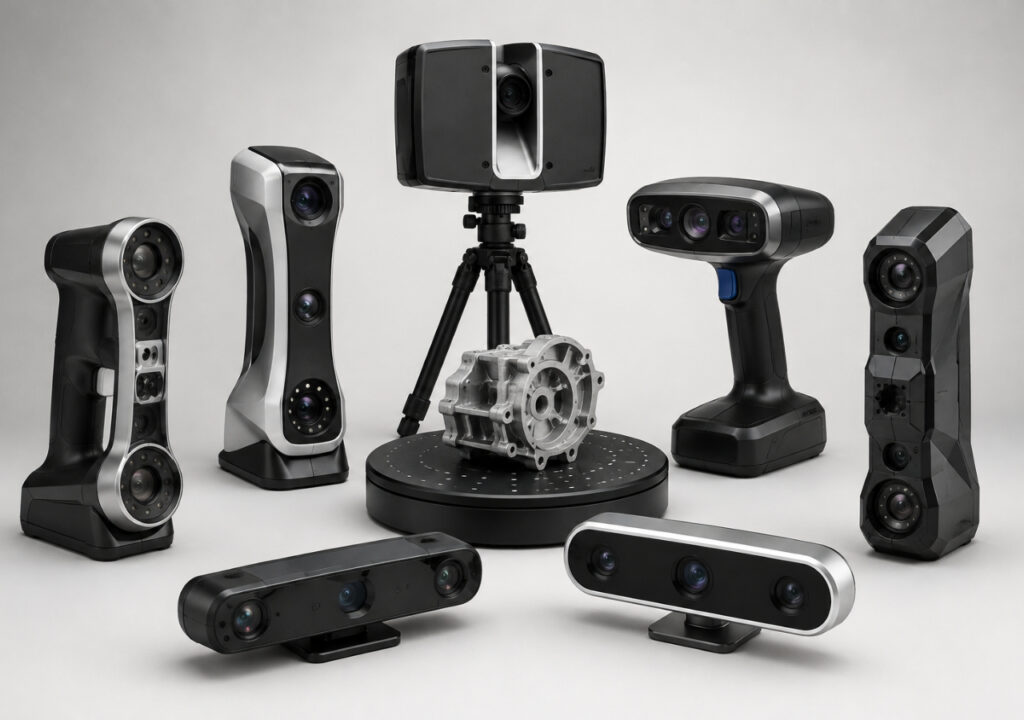
- Creaform HandyScan Pro Series has accuracy of up to 0.03 mm, uses Laser Triangulation technology, has a working distance of 50 mm – 4 m.
- Shining 3D EinScan Libre has accuracy of up to 0.05 mm, uses Laser Triangulation & IR technology, has a working distance of 200 mm – 1.2 m.
- Scantech Simscan Gen2 has accuracy of up to 0.020 mm, uses Laser Triangulation technology, has a working distance of up to 300 mm.
- Artec Point has accuracy of up to 0.02 mm, uses Laser Triangulation technology, has a working distance of 300 – 1,200 mm.
- Zeiss T-Scan Hawk 2 has accuracy of up to 0.02 mm, uses Laser Triangulation technology, has a working distance of up to several meters.
- Hexagon Atlascan Pro has accuracy of up to 0.02 mm, uses Structured Light & Laser Triangulation technology, has a working distance of 200 – 650 mm.
What’s New Since The Last Update?
This year’s guide replaces the Creaform HandyScan Silver Series with the newer HandyScan Pro Series, updates the Scantech Simscan-E to the Simscan Gen2, and introduces the Hexagon Atlascan Pro while continuing to recommend the Atlascan Max for advanced industrial users.
Industrial 3D Scanners
Creaform HandyScan Pro Series
The HandyScan Pro Series offers metrology-grade scanning with approximately 0.03 mm accuracy and includes Scan-to-CAD Pro software for streamlined CAD workflows. Positioned above the Silver Series, it provides improved precision and software integration for engineering, product development, and industrial inspection.
For businesses that require accurate and reliable scanning solutions, the Best 3D Scanner options often depend on specific requirements such as accuracy, scanning speed, portability, and intended application.
Shining 3D EinScan Libre
The EinScan Libre is a standalone wireless scanner capable of processing scan data directly on the device using an NVIDIA Jetson Orin NX processor. Users can create and export 3D models without relying on an external computer.
It supports blue laser and infrared scanning, features a built-in display, and provides real-time quality indicators. The laser mode focuses on highly detailed objects, while infrared scanning is suited for larger scenes and environments. Although its accuracy is lower than the EinScan HX2, the Libre excels in full-color texture capture and portability.
Scantech Simscan Gen2
The Simscan Gen2 builds upon the Simscan-E with improved laser density and higher precision. It delivers up to 5.8 million measurements per second and 0.02 mm accuracy.
Its three scanning modes—Ultra-Fast, Hyperfine, and Deep Hole—allow it to capture detailed industrial components and hard-to-reach areas. Lightweight construction and integration with Definsight software make it ideal for professional inspection and reverse engineering.
Artec Point
The Artec Point is a handheld, ISO-certified laser 3D scanner with an accuracy of up to 0.02 mm, making it well suited for quality control and reverse engineering. It captures black, shiny, and complex surfaces using multiple scanning modes, including Grid, Parallel Lasers, and Single Laser modes. With scanning speeds of up to 120 frames per second, HD cameras, and up to 8× magnification, it provides fast, detailed scans while integrating seamlessly with Artec Studio software.
Zeiss T-Scan Hawk 2
The Zeiss T-Scan Hawk 2 combines red and blue laser technologies to scan everything from fine details to large objects. Its Satellite Mode allows users to scan objects several meters in size, while Projection Mode uses a red laser marker to help position the scanner accurately. Built-in controls enable users to operate the scanner directly without constantly switching to a laptop. The included GOM Inspect Suite software supports inspection, reverse engineering, 3D printing, and reporting.
Hexagon Atlascan Pro
Hexagon expanded its handheld scanner lineup with the Atlascan series, designed for professional inspection and reverse engineering. The Atlascan Pro simplifies industrial laser scanning with intuitive controls, multiple scanning modes, and compatibility with Geomagic Design X Go software. It captures large areas at millions of points per second while maintaining professional-level accuracy, making it a practical choice for small and medium-sized businesses, R&D teams, and educational institutions.
Which Type of 3D Scanner Is Best?
Choosing the right 3D scanner starts with understanding what you need to scan. Small objects that can be brought into an office or workshop may be suitable for stationary scanners, while larger parts, machinery, or on-site projects often require handheld portable scanners.
Other important considerations include object size, surface material, required accuracy, portability, and intended application. For example, reverse engineering and quality inspection demand highly accurate measurements, while digital visualization and game development may prioritize texture quality over dimensional precision.
Reflective and transparent surfaces can be difficult for many scanners, although applying a temporary matte coating can often improve scan quality.
Laser Triangulation vs. Structured Light
Most modern professional scanners use either laser triangulation, structured light, or a combination of both technologies. Each offers unique advantages depending on the application.
Laser Triangulation
Laser triangulation works by projecting laser lines or points onto an object’s surface and measuring the reflected light to calculate precise distances. It is widely used in industrial handheld scanners because it provides exceptional accuracy—often within a few hundredths of a millimeter.
Different laser technologies are used depending on the scanning distance. Time-of-flight and phase-shift methods are better suited for large-scale scanning, while laser triangulation is preferred for smaller objects that require detailed measurements. Although highly accurate, this technology performs less effectively on transparent or highly reflective materials.
Structured Light
Structured light scanners project light patterns instead of laser beams onto an object. By analysing how these patterns deform across the surface, the scanner reconstructs an accurate 3D model.
This technology is safe for scanning people and animals and is commonly found in both consumer and professional scanners. While structured light provides excellent detail, it performs best in indoor environments where lighting conditions can be controlled. Larger objects usually require multiple scans that are later stitched together into a complete model.
For applications such as product development, prototyping, and manufacturing, a 3D Scanner for 3D Printing can provide accurate digital models that can be converted into printable files and used for creating physical prototypes.
Conclusion
Industrial 3D scanning technology continues to evolve, offering greater speed, precision, and flexibility than ever before. From compact handheld devices such as the FARO Leap ST and Scantech Simscan Gen2 to powerful standalone solutions like the EinScan Libre and advanced metrology systems from Zeiss, Artec, Creaform, and Hexagon, there are solutions available for nearly every professional application.
Selecting the right scanner depends on your specific requirements, including object size, surface characteristics, portability, accuracy, and budget. By understanding the strengths of laser triangulation and structured light technologies, businesses can choose a scanner that delivers reliable results for reverse engineering, inspection, product development, manufacturing, and digital documentation.
Companies that require specialised scanning capabilities without investing in equipment can consider Outsource 3D Scanning services to access professional expertise, advanced technology, and accurate results for their projects. To learn more about suitable scanning solutions, connect with our team for professional guidance and support.