
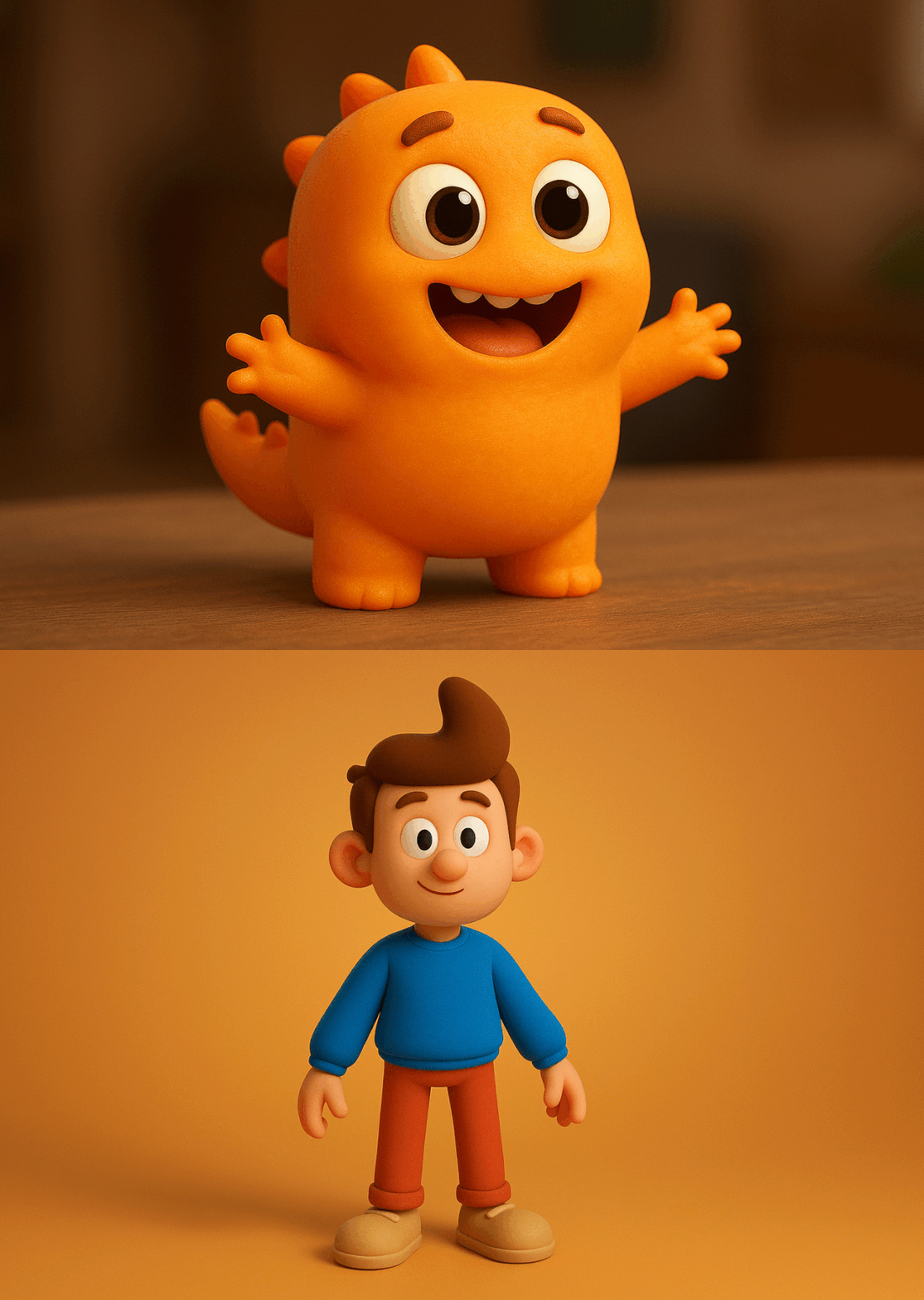
The 3D Animation market is rapidly changing as a result of the new technology and transformations in the industry. New trends such as real-time rendering and animation generated by AI are transforming the production and consumption of animated materials. The new trends such as hyper-realistic characters, virtual worlds, and renewable animation are opening new possibilities to both the animators and the companies.
Following are the top 10 trends influencing the 3D animation market:
Table of Contents:
1.Real-Time Rendering & Game Engine Integration:
2.AI-Powered Automation & Machine Learning
3.Virtual Production & Digital Cinematography
4.Cloud-Based Collaboration & Rendering
5.Immersive AR/VR Integration
6.The Rise of the Metaverse & NFT
7.Photorealism & Advanced Rendering Technologies
8.Innovations in Motion & Performance Capture
9.Interactive & Gamified Content
10.Sustainability & Energy-Efficient Production Practices
Conclusion:
1.Real-Time Rendering & Game Engine Integration:
The is being revolutionized by real-time rendering, which enables creators to experience real-time changes without experiencing tedious processing. Animation, film-making, and virtual experiences are common applications of game engines such as Unreal Engine and Unity. These tools enable studios to produce quality visuals in a shorter period and at a low cost. This trend is being fuelled by the need to have interactive content in the field of gaming, virtual production as well as simulations
In November 2024 Epic Games launched its new Unreal Engine 5.5 game engine with major updates to its Nanite and Lumen technology, which significantly enhance the rendering of complex 3D scenes and allow real-time animation of highly detailed environments.
2.AI-Powered Automation & Machine Learning
Automation with AI is facilitating animation processes by automating the complex tasks such as motion capturing, character rigging, and facial animation. The machine learning algorithms process large amounts of data to make realistic movements and expressions with minimum human intervention. This technology saves time and expenditure of production and enhances quality of animation. Many a 3D Animation Studio In Malaysia is now beginning to explore AI tools to boost creative efficiency and production speed.
Wonder Dynamics introduced Wonder Animation, a 3D animation technology using artificial intelligence, in October 2024. The new tool converts video recordings into fully animated 3D sequences, making production of animated films faster with artists still having the control. The innovation indicates the increasing presence of AI in the 3D animation market to enhance efficiency and broaden the creative opportunities of studios.
3.Virtual Production & Digital Cinematography
Virtual production is changing the world of filmmaking as it involves the unity of 3D animation in real-time and live-action shooting. LED walls are high resolution and enable filmmakers to shoot realistic scenes without having to undergo a lot of post-production. Digital cinematography has the advantage of improved motion tracking and lighting changes in real-time, which produces quality images in a cost-effective way. This method has been commonly adopted in movies, television shows, and advertisements where the creativity is improved at a lower cost and less time.
4.Cloud-Based Collaboration & Rendering

The 3D animation is enhancing efficiency through cloud-based collaboration because groups can work on common projects remotely. Without wasting money on hardware investments, studios can access the powerful cloud rendering services, accelerating the production process and cutting costs. The use of real-time updates and seamless integration provides the possibility of animators, designers, and developers to collaborate with each other in different places. This trend is catalyzing scalability, flexibility, and turn around time in the sphere of animation and visual effects.
5.Immersive AR/VR Integration
Through the use of augmented reality (AR) and virtual reality (VR), animators are continuing to innovate and dream of new ways to produce and experience 2D -3D Animation Video Production through immersive virtual and interactive experiences. Augmented reality and virtual reality allow animators to use 3D modeling techniques to create a realistic simulation of a virtual environment for audiences in which they can live and interact with characters associated with the virtual environment. The need for high-quality AR/VR content is becoming evident as more industries, including entertainment, education, and health care demand a range of visual content for development, production, and deliverables. As AR/VR continues to develop, many animation tools and innovative techniques will rarely be released to enhance user engagement.
6.The Rise of the Metaverse & NFT
As the metaverse continues to be built out across virtual reality and AR, the metaverse is driving demand for 3D animation as companies and virtual reality/AR experiences develop virtual worlds for social interaction, gaming and commerce. 3D animators must create animated assets with avatars, environments and interactive objects that allow or support interactivity. Digital assets and 3D animation allow for an experience worthy of marrying interactive and immersive experiences with the possibilities of the metaverse. The use and development of NFT (non-fungible tokens) has enabled animators to monetize worth and value in the form of digital art and 3D animation and assets while protecting the intellectual property of the creator associated with that digital art. Through NFTs and digital ownership, creators can now benefit from expanded opportunities while providing a new way to experience and relate to the importance of ownership, value and trade.
In July, 2024, Walmart launched Walmart Realm, an immersive shopping platform that allows consumers to explore curated virtual environments created by online creators and purchase products using in the metaverse on the platform. The notion of creating these development and immersive platforms requires high levels of investment in 3D modeling and animation in addition to design and strategy to build virtual worlds, resulting in continued innovations and expansion of 3D animation into the virtual spaces, further fueling demand for expert Animation Services Near Me and globally.
7.Photorealism & Advanced Rendering Technologies
As rendering technologies have advanced in the last couple of years, photorealism has also emerged as a focus in 3D animation. Raytracing, global illumination, and AI-based upscaling all help with light, shadows, and textures to create images that feel real. Industries like film, gaming, and advertisements are using new technologies to achieve hyper-realistic animate visualizations. The demand for more visual content is causing studios to invest in advanced rendering technologies that improve realism and are efficient at making the images.
8.Innovations in Motion & Performance Capture
Motion and performance capture technologies are advancing to create more realistic character animations. New smart sensors, AI-driven tracking, and real-time data processing make it easier for animators to capture low-profile facial expressions and movements of bodies. New technologies are substantially used in films, gaming, and virtual reality, improving storytelling and realism of the character. Demand for realism in digital humans is causing constant improvements of the motion capture systems.
9.Interactive & Gamified Content
Interactive and gamified content is transforming the 3D animation industry by making experiences more interesting and immersive. Animators are introducing real time interactions in story telling, marketing, and teaching to enhance user participation. In animated content, there is application of gaming mechanics such as reward and changing stories across various industries. This is creating demand for animations that change based on user input and are therefore personalized and interactive.
10.Sustainability & Energy-Efficient Production Practices
The concept of sustainability is also gaining increasing emphasis in the 3D animation industry with the studios emphasizing on energy efficient production methods. Efficient rendering tasks, AI-based applications, and cloud computing minimize the footprint and use resources. There is also a concern of companies minimizing the waste of hardware, and working in a virtual workstation as well as co-operating in a cloud environment. The rapid pressure to achieve green initiatives is contributing towards advancement of innovation and improved process and technology. A forward-thinking 3D Animation Studio will incorporate these practices as standard, ensuring a responsible and future-ready production model.
Conclusion:
Advancements in real-time rendering and AI automation, among other things, are rapidly transforming the 3D animation industry. Due to these emerging technologies, augmented reality (AR), virtual reality (VR) and the metaverse are becoming more immersive. Virtual production is transforming the future of film, and motion capture and photorealistic rendering are reaching new heights of realism. Simultaneously, creators are getting new opportunities with the development of new interactive content and blockchain. With the development of technology, 3D animation will definitely go on pushing the boundaries of creativity and technology even further in other sectors.
We’d love to hear from you. Whether you have a question, need support, or want to explore how we can work together, Reach Out and let’s connect.